Why Your Leadership Offsite Didn't Change Anything, and How to Make the Next One Stick
The short answerLeadership offsites usually fail to change anything because they produce agreement without commitment. Teams leave with shared enthusiasm but without named owners, deadlines, or changes to how the week actually runs. Within weeks, the existing calendar and habits take over again. Offsites stick when they're designed backward from specific decisions and followed by a deliberate operating rhythm.
The offsite was great. Nothing changed. You've probably lived some version of it. Two days of candor and energy. Good dinners. A whiteboard full of commitments and a team that finally felt aligned. Six weeks later the calendar looks exactly the same, the old arguments are back, and nobody can quite remember what was decided.
Five reasons offsites fade
1. Agreement isn't commitment
Nodding along in a room is easy. Commitment means one named person owns an outcome, by a specific date, and everyone else knows it. An offsite that ends in broad agreement has produced a feeling, not a decision.
2. "We should" has no owner
"We should" is the most dangerous phrase at an offsite. It sounds like a decision and assigns nobody. Every "we should" that leaves the room without a name attached is, in practice, a "we won't."
3. Memory fades fast
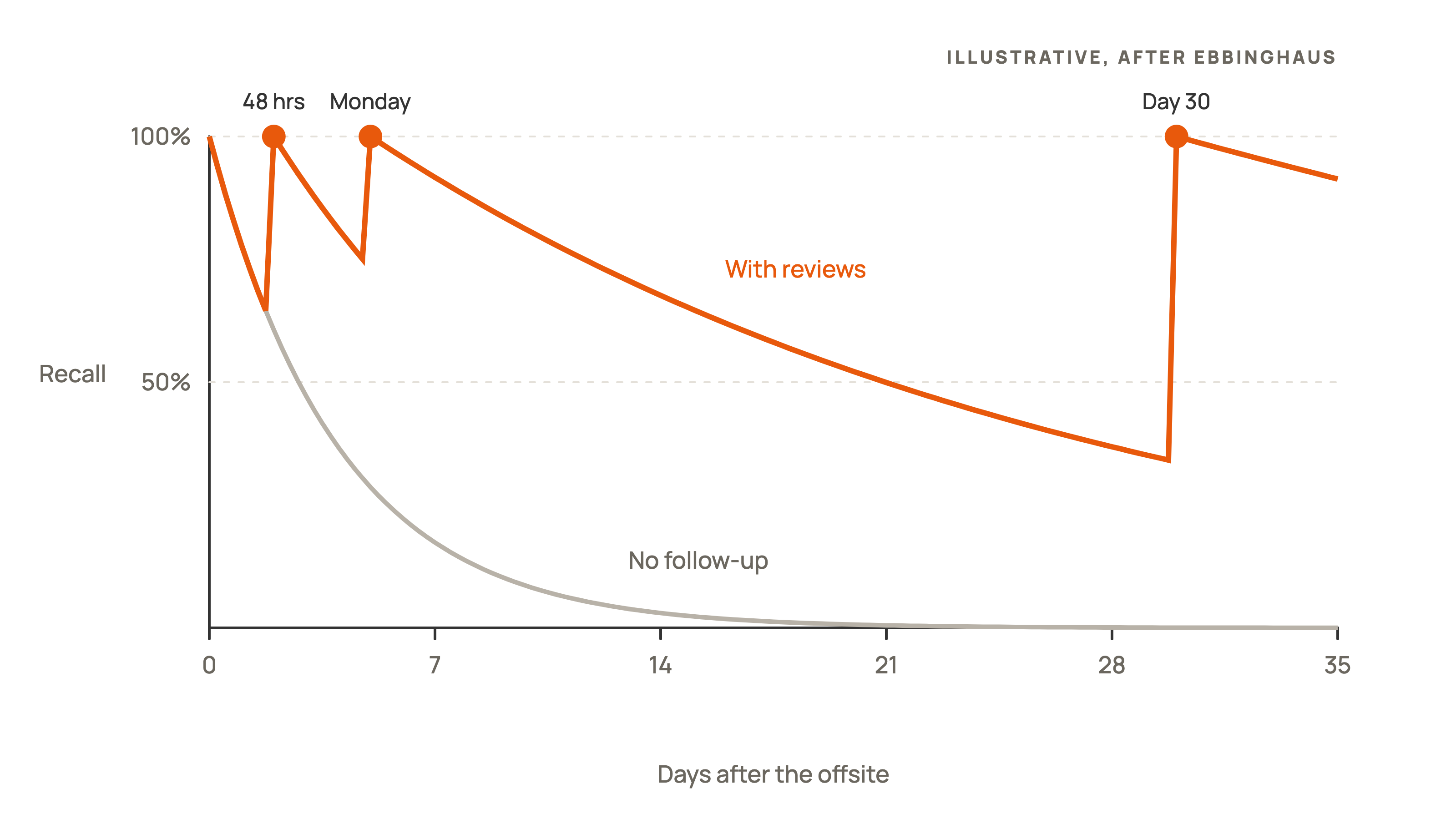
In the 1880s, psychologist Hermann Ebbinghaus showed that newly learned information fades steeply in the first days after learning unless it's reviewed. Researchers replicated his forgetting curve in 2015. What felt vivid on Thursday afternoon is hazy by the following Thursday, and nobody notices the moment it slips.
4. Monday wins
The offsite changes minds. The calendar governs behavior. If the standing meetings, the metrics, and the decision paths are the same on Monday as they were before, the old behavior returns, because the old structure is still asking for it.
5. Nobody changed the operating rhythm
Most offsites end with a plan and no mechanism for revisiting it. Without a built-in moment to check progress, the plan competes with every urgent thing that lands in the inbox. Urgent wins.
How to make the next offsite stick
The fix starts before anyone books a venue and continues long after everyone flies home.
Before the offsite
- Decide what the offsite must decide. Write down the three decisions you need to leave with. If you can't name them, you aren't ready to hold the offsite.
- Move information out of the room. Send updates and data ahead of time, so the time together is spent deciding rather than presenting.
- Invite the people who own the decisions. Observers dilute candor. Decision makers create it.
During the offsite
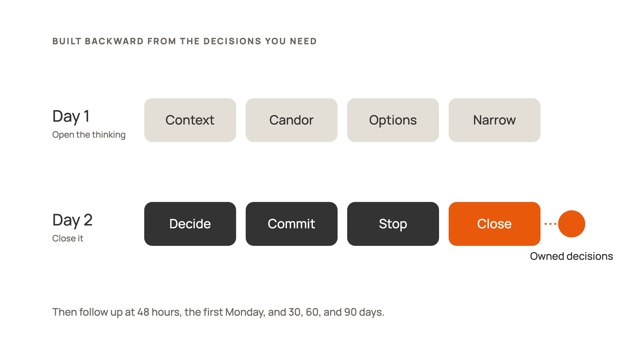
- Turn every agreement into an owner, a date, and a first step. This is the single highest-leverage habit. A meta-analysis of 94 independent studies by Peter Gollwitzer and Paschal Sheeran found that forming specific "if this, then I will do that" plans had a medium-to-large effect on whether people followed through on their goals.
- Name what you'll stop doing. New priorities need room. If nothing comes off the list, the new work gets done in the margins, which means it doesn't get done.
- Agree on what you'll tell the rest of the company. The team should be able to explain the decisions in the same words. If the message differs by leader, the decisions will too.
After the offsite
- Send the decision record within 48 hours, while memory is fresh.
- Review it at the first Monday leadership meeting. That meeting signals whether the offsite was real.
- Put 30, 60, and 90 day check-ins on the calendar before you leave the room.
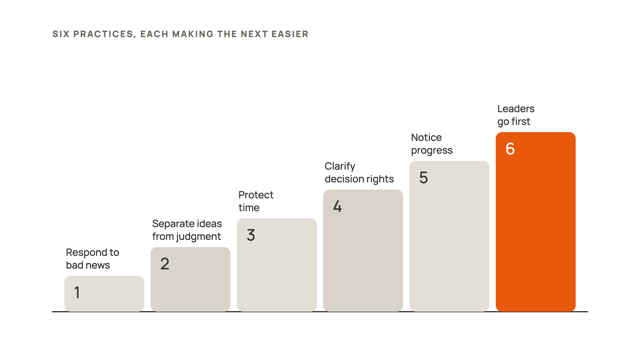
- Make progress visible and notice it. Research by Teresa Amabile and Steven Kramer found that making progress in meaningful work is the strongest positive force in people's workdays. Early wins keep momentum alive.
An offsite follow-up checklist
Use this the week after any leadership offsite:
- Decision record sent within 48 hours
- Every commitment has exactly one owner and a date
- 30, 60, and 90 day reviews are on the calendar
- At least one recurring meeting has changed
- The team agreed on at least one thing to stop doing
- Team members can explain the decisions in their own words
If you can't check most of these boxes, the offsite produced energy, and energy has a short shelf life.
When to bring in outside help
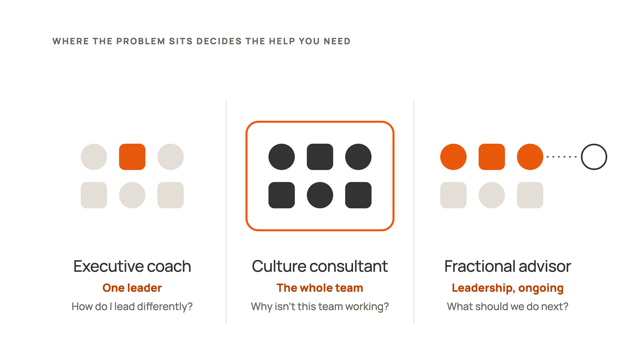
An outside facilitator lets the leader actually participate instead of running the room, and brings a neutrality that makes candor easier. The more valuable role is often the one that comes after: an outside voice who holds the team to the rhythm it agreed to, at the 30, 60, and 90 day marks when the urgency has faded and the old habits are pulling hardest.
Frequently asked questions
How long should a leadership offsite be?
Many leadership offsites run one to two days. Length matters less than design. A focused day built around three specific decisions usually beats a loose three days of discussion. Plan the decisions first, then choose the length that gives them enough room.
How often should a leadership team hold an offsite?
Many leadership teams hold a full offsite once or twice a year, supported by shorter quarterly working sessions. The quarterly sessions do most of the follow-through, since they're where the team checks progress against what it committed to and adjusts.
Who should facilitate a leadership offsite?
An outside facilitator is often the best choice, because it frees the leader to participate fully and adds neutrality to hard conversations. If the leader facilitates, they should name that they're playing two roles and invite the team to challenge them.
What should happen after a leadership offsite?
Within 48 hours, the team should receive a written record of every decision, with one owner and one date each. The first leadership meeting afterward should review that record, and 30, 60, and 90 day check-ins should already be on the calendar.
Sources
- Ebbinghaus, H. (1885). Über das Gedächtnis (Memory: A Contribution to Experimental Psychology).
- Murre, J. M. J., and Dros, J. (2015). Replication and analysis of Ebbinghaus' forgetting curve. PLOS ONE, 10(7), e0120644. journals.plos.org
- Gollwitzer, P. M., and Sheeran, P. (2006). Implementation intentions and goal achievement: A meta-analysis of effects and processes. Advances in Experimental Social Psychology, 38, 69-119.
- Amabile, T. M., and Kramer, S. J. (2011). The Progress Principle. Harvard Business Review Press.