How to Run a Leadership Offsite: An Agenda That Produces Decisions
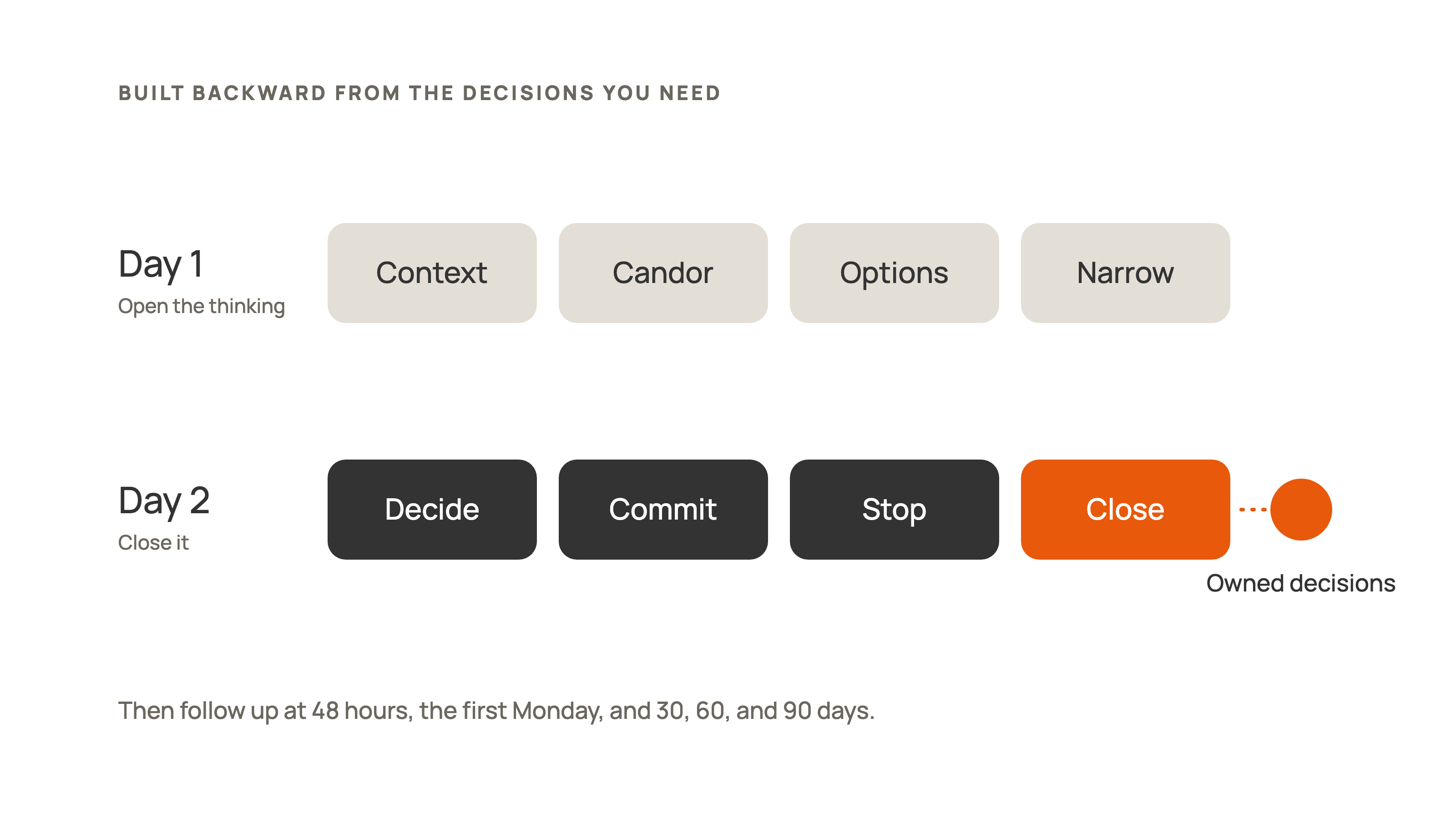
The short answerA good leadership offsite agenda is built backward from the three to five decisions the team must leave with. Day one creates shared context and candor, then lays out real options. Day two makes the decisions and turns each one into an owner, a date, and a first step. Follow-up is scheduled before anyone leaves.
Most offsite agendas are built forward: a list of topics that feel important, filled in until the time runs out. That's how teams end up with two good days and nothing to show for them, a pattern covered in Why Your Leadership Offsite Didn't Change Anything. This is the practical companion: an agenda designed to produce decisions.
Before you build the agenda
Three things need to happen before anyone books a room.
Name the decisions. Write down the three to five decisions the offsite must produce. "Discuss strategy" isn't a decision. "Choose which two of our five priorities we fund next year" is. If you can't name the decisions, you aren't ready to hold the offsite.
Move information out of the room. Send updates, data, and background reading a week ahead. Time together is for deciding, not presenting slides people could have read on their own.
Invite the people who own the decisions. Every person in the room should have a stake in at least one decision. Observers dilute candor.
A sample two-day agenda
Adjust the times to your team, but keep the shape. Day one opens the thinking. Day two closes it.
| When | Session | Purpose | Output |
|---|---|---|---|
| Day 1, morning | Context | Agree on where things stand, using the pre-read | A shared picture of reality |
| Day 1, late morning | Candor | What's working, what isn't, and what nobody's saying | A short list of the real issues |
| Day 1, afternoon | Options | Generate options for each decision before judging any | Two or three real options per decision |
| Day 1, close | Narrow | Name the trade-offs and choose what to decide tomorrow | A clear agenda for day two |
| Day 2, morning | Decide | Make each decision, with one person accountable for it | Decisions made |
| Day 2, late morning | Commit | Turn every decision into an owner, a date, and a first step | A commitment list |
| Day 2, afternoon | Stop | Name what the team will stop doing to make room | A stop list |
| Day 2, close | Close | Agree how to explain the decisions, and schedule follow-up | A shared message and calendar dates |
How to run the sessions that matter most
Separate generating options from deciding
The afternoon of day one is for options only. When teams judge ideas the moment they're spoken, the fastest and most senior voices win by default. Have people write ideas down silently before discussing them, and hold the evaluation until the options are on the table.
Decide who decides
Before each decision, say out loud who makes the final call and who's consulted. Many stalled decisions aren't disagreements. They're unclear ownership. A decision with no clear decision-maker becomes a discussion that never ends.
Turn agreement into commitment
Every decision leaves the room with one owner, a date, and a first step. Research supports this. A meta-analysis of 94 studies by Peter Gollwitzer and Paschal Sheeran found that forming specific if-then plans had a medium-to-large effect on whether people followed through on their goals.
Make room by stopping something
New priorities need time and attention from somewhere. If nothing comes off the list, the new work happens in the margins, which means it mostly doesn't happen.
A one-day version
When two days aren't possible, keep the same shape and compress it. Spend the morning on context, candor, and options for no more than three decisions. Spend the afternoon deciding, committing, and closing. Fewer decisions, made well, beat a long list made badly.
Close so it sticks
The last hour is the most important part of the offsite. Before anyone leaves:
- Read back every decision, its owner, and its date
- Agree on the message to the rest of the company, in the same words
- Put the 30, 60, and 90 day check-ins on the calendar
- Confirm who sends the written decision record, and when
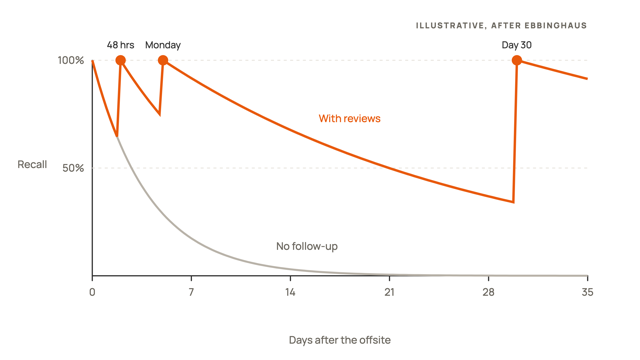
Then send that record within 48 hours, and review it at the first leadership meeting back. Research by Teresa Amabile and Steven Kramer found that making progress in meaningful work is the strongest positive force in people's workdays, so early, visible progress keeps momentum alive.
Common agenda mistakes
- Too many topics. Ten agenda items guarantee shallow decisions on all of them.
- Presentations instead of discussion. If it could have been an email, send it as an email beforehand.
- Team building as a substitute for hard conversations. Shared activities can help, but they don't replace candor.
- No time to close. Running over on day two and skipping the close undoes the whole offsite.
Frequently asked questions
How long should a leadership offsite be?
Many leadership offsites run one to two days. Two days gives room to open the thinking on day one and close it on day two. A focused single day works for three or fewer decisions. Length matters less than whether the agenda is built around specific decisions.
What should be on a leadership offsite agenda?
A strong agenda moves from shared context, to candid discussion of real issues, to generating options, to making decisions, to turning each decision into an owner, a date, and a first step. It ends by agreeing what to stop, how to communicate decisions, and when to follow up.
Who should facilitate a leadership offsite?
An outside facilitator often works best, because it lets the leader participate fully and adds neutrality to difficult conversations. If the leader facilitates, they should name that they're playing two roles and invite the team to challenge them.
Should a leadership offsite include team building?
It can, in moderation. Shared activities and good meals help people connect, which supports candor. They work best as a complement to the hard conversations, not a replacement for them. Keep the core of the agenda focused on decisions.
What pre-work should leaders do before an offsite?
Send background data, updates, and any reading at least a week ahead, along with the list of decisions the offsite will make. Ask each leader to come with a point of view on each decision, so the time together goes to deciding rather than catching up.
Sources
- Gollwitzer, P. M., and Sheeran, P. (2006). Implementation intentions and goal achievement: A meta-analysis of effects and processes. Advances in Experimental Social Psychology, 38, 69-119.
- Amabile, T. M., and Kramer, S. J. (2011). The Progress Principle. Harvard Business Review Press.