Executive Coach, Culture Consultant, or Fractional Advisor? How to Choose
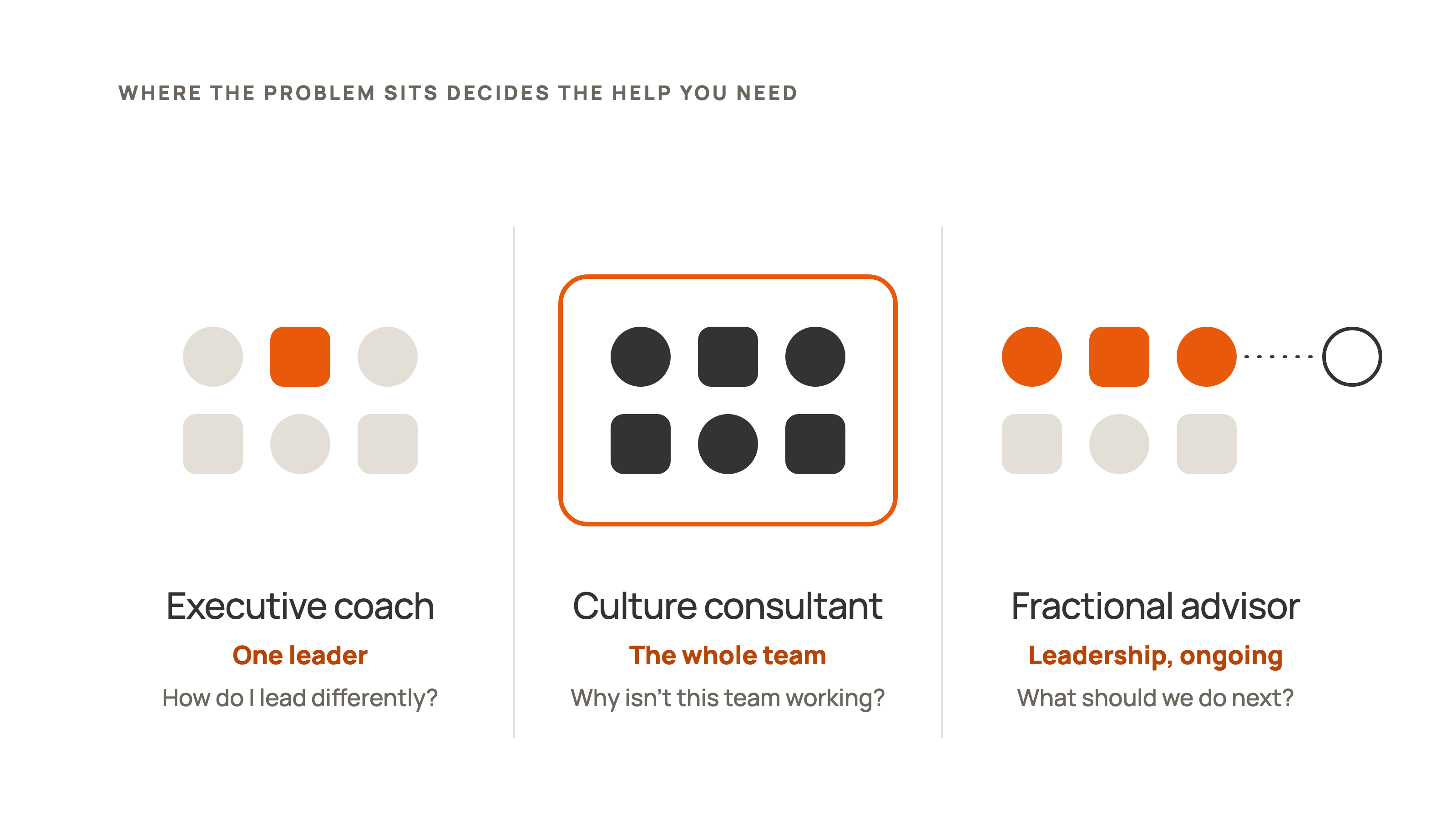
The short answerAn executive coach works one-on-one with a leader to change how that person leads. A culture consultant works across a team or company to change how people work together. A fractional advisor joins your leadership part time, ongoing, to help steer decisions. The right choice depends on where the problem sits: one person, the system, or leadership capacity.
Leaders often reach for the wrong kind of help because the symptoms look alike. A stalled team can be a leadership problem, a culture problem, or a capacity problem, and each one needs a different fix. Getting the diagnosis right saves months.
The short version
| Executive coach | Culture consultant | Fractional advisor | |
|---|---|---|---|
| Works with | One leader | A team or a whole organization | The leadership team, ongoing |
| Core question | How do I need to lead differently? | Why isn't this team working the way it should? | What should we do next, and how? |
| Typical shape | Regular one-on-one sessions over several months | A defined engagement: diagnosis, design, rollout | A monthly retainer of standing time |
| Who does the work | The leader, with the coach as a thinking partner | The team, with the consultant designing and facilitating | Shared. The advisor brings judgment, the team executes. |
| Success looks like | The leader behaves differently, in ways others notice | The team's habits and norms change | Better decisions, made faster, with fewer blind spots |
| Wrong choice when | The real problem is the system around the leader | The real problem is one leader's behavior | You need a full-time executive |
When you need an executive coach
You need an executive coach when the thing holding results back is how one leader leads. Coaching works on that person's habits, decisions, and blind spots, in confidence, over enough time for new behavior to take hold.
Signs it's coaching:
- You were promoted past the skills that got you here
- The feedback you keep hearing is about how you lead, not what you deliver
- You're carrying decisions you can't talk through with anyone inside the company
- You're a founder whose company outgrew the way you used to run it
Good coaching is confidential, direct, and built around decisions that are actually on your desk this month. It is not therapy and it is not training. A good coach asks harder questions than your team will.
Coaching is a large and growing field. The International Coaching Federation's 2025 Global Coaching Study, conducted by PwC, counted a record 122,974 coach practitioners worldwide and put industry revenue at $5.34 billion. More choice makes credentials and fit matter more, not less.
When you need a culture consultant
You need a culture consultant when capable people keep producing mediocre results together. The problem lives in the system: the rituals, decision rights, and unwritten norms that shape how work actually happens. Changing one leader won't fix it.
Signs it's culture:
- Good people, mediocre outcomes
- The same conflicts repeat with different faces
- Ideas die in meetings, or never get raised at all
- Growth broke habits that used to work
A culture consultant maps how ideas and decisions really move through the company, then redesigns the structures around them. The stakes are real. Gallup's State of the Global Workplace: 2026 Report found that only 20% of employees worldwide were engaged at work in 2025.
When you need a fractional advisor
A fractional advisor is a senior outside leader who works with your leadership team part time on an ongoing basis, usually through a monthly retainer. Unlike a consultant, the relationship doesn't end when a project does. The advisor stays close enough to be useful and far enough outside to stay honest.
Signs it's a fractional advisor:
- You're in a stretch of growth, transition, or reinvention
- You need senior perspective but not a full-time hire
- Your leadership team would benefit from a steady outside voice
- Decisions are stacking up with no one to pressure-test them
Fractional leadership is growing quickly. Revelio Labs found that 24 of every 1,000 new executive positions advertised in 2026 were fractional, up from nine five years earlier.
A fractional advisor is different from a fractional executive. A fractional executive, such as a fractional CMO or CFO, holds an operating role and owns results in a function. A fractional advisor counsels the people who hold those roles.
Can you combine them?
Often, yes. Many engagements start as one and grow into another. A leader in coaching realizes the team around them needs work. A culture engagement surfaces one leader who needs individual support. A fractional relationship becomes the steady thread that holds both together.
The useful question isn't which one is best. It's which one fits the problem in front of you right now.
Questions to ask before you hire anyone
- What specifically will be different in 90 days?
- How will we know it's working?
- Who does the work between sessions?
- What happens if it isn't a fit?
Anyone worth hiring will answer all four plainly.
Frequently asked questions
What is the difference between a coach and a consultant?
A coach helps a leader find their own answers and change their own behavior. A consultant diagnoses a problem in a team or organization and designs a solution for it. Coaching focuses on the person. Consulting focuses on the system. Some work blends both.
What does a fractional advisor do?
A fractional advisor gives a leadership team senior outside judgment on a part-time, ongoing basis. That usually means a monthly rhythm of working sessions, coaching, and counsel on real decisions, without the cost or commitment of a full-time executive hire.
How long does executive coaching usually last?
Executive coaching often runs several months or longer, because changing how someone leads takes repetition in real situations. Short engagements can help with a specific transition or decision. Lasting behavior change usually needs more time than a few sessions provide.
Is a fractional advisor the same as a fractional executive?
No. A fractional executive, such as a fractional CMO or CFO, holds an operating role and is accountable for a function's results. A fractional advisor counsels leaders and leadership teams without taking over an operating role.
Should I see a coach or a therapist?
Coaching focuses on work, leadership, and future action. Therapy addresses mental health, emotional wellbeing, and clinical concerns. The two can complement each other. A responsible coach will recognize when someone needs a therapist and say so.
Sources
- International Coaching Federation. (2025, September 15). 2025 ICF Global Coaching Study: Executive Summary. Conducted by PwC. coachingfederation.org
- Gallup. (2026, April). State of the Global Workplace: 2026 Report. gallup.com
- Revelio Labs. (2026, September 29). Fractional executive roles. reveliolabs.com