How to Build a Creative Thinking Culture: Six Practices That Last
The short answerA creative thinking culture is one where people regularly raise new ideas, challenge assumptions, and try things, because the environment makes it safe and practical to do so. Leaders build it through everyday habits: how they respond to bad news, how meetings separate generating ideas from judging them, how decisions get made, and whether progress gets noticed.
Most companies already employ creative people. The question is whether the environment lets that creativity show up on an ordinary Tuesday, or only at the annual offsite.
Why creative thinking is a culture problem
Creative thinking depends far more on how a team works together than on who is on it. Research from Google, Harvard, and Gallup points the same direction: the environment leaders create decides whether people's ideas ever reach the room.
The engagement gap is wide. Gallup's State of the Global Workplace: 2026 Report found that only 20% of employees worldwide were engaged at work in 2025. People who are disengaged rarely volunteer the half-formed idea that turns into the next good decision.
Google studied the question directly. In its Project Aristotle research on what makes teams effective, Google's People Analytics team concluded that who was on a team mattered less than how the team worked together. Of the five dynamics it identified, psychological safety came first and underpinned the other four. Google reported that people on teams with higher psychological safety were less likely to leave, more likely to harness diverse ideas from teammates, brought in more revenue, and were rated as effective twice as often by executives.
Harvard Business School professor Amy Edmondson, whose research established the concept, defines team psychological safety as "a shared belief held by members of a team that the team is safe for interpersonal risk taking."
Teresa Amabile and Steven Kramer added the daily view. Analyzing nearly 12,000 diary entries from 238 people across seven companies, they found that making progress in meaningful work was the most powerful positive force in people's workdays. Creativity rises when people can see their work moving.
Six practices that build a creative thinking culture
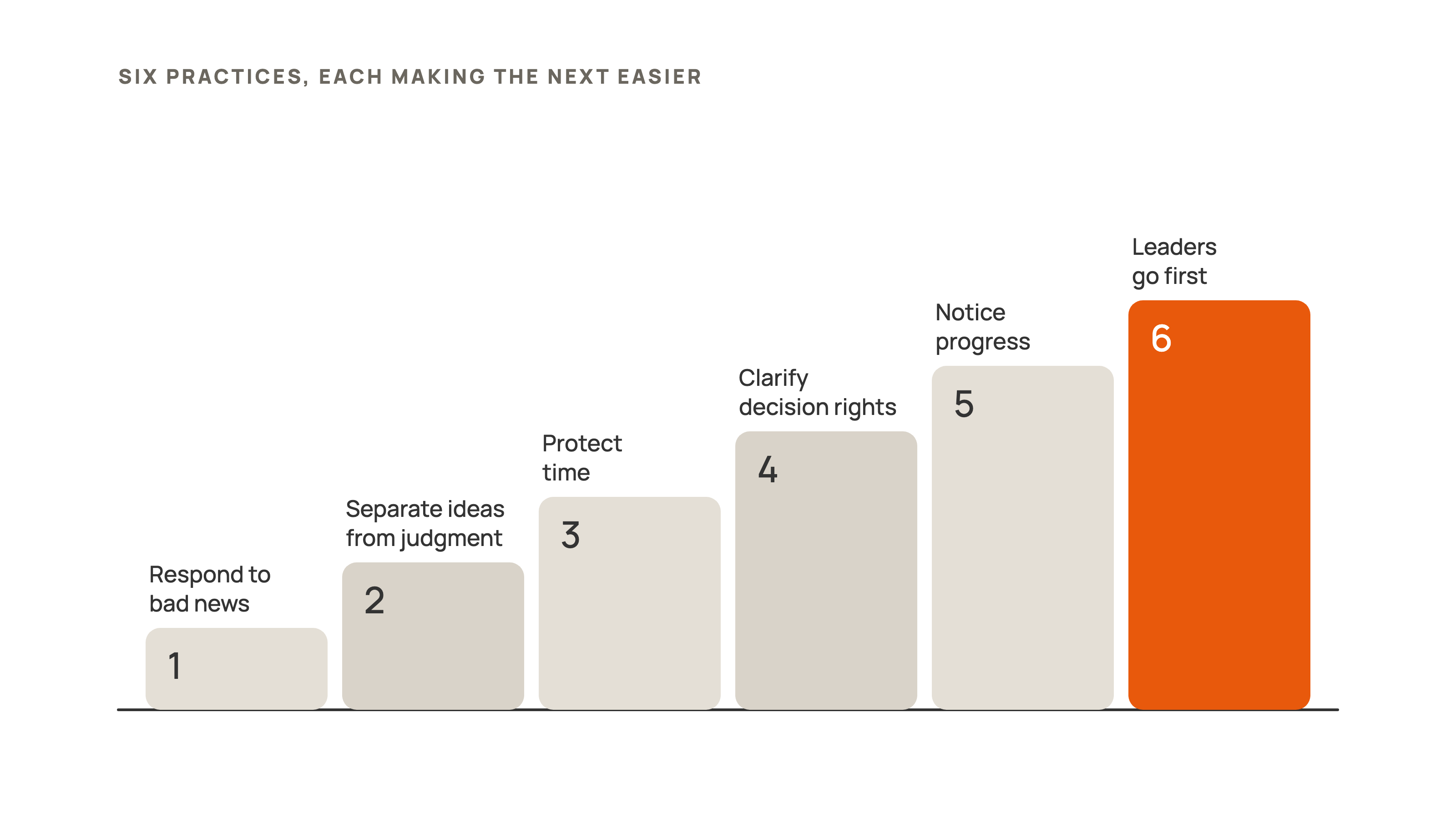
These practices work best in roughly this order, because each one makes the next easier to sustain.
1. Change how you respond to bad news
The fastest signal of safety on any team is how the leader reacts to a mistake or a dissenting view. If the messenger pays a price, people stop bringing messages. Thank the person first. Ask what they learned. Then fix the problem together. Do that consistently and bad news starts arriving earlier, which is when it's cheapest to act on.
2. Separate generating ideas from judging them
Most meetings evaluate an idea the moment it's spoken, which rewards the fastest, loudest, and most senior voices. Give ideas room before critique. Have people write ideas down silently before discussion, or run the session that generates options apart from the session that decides between them. You'll hear from people who usually stay quiet.
3. Protect time on the calendar
Creative thinking needs uninterrupted time, and the calendar is the most honest statement of what a company values. If every hour is booked with status updates, nobody has room to think. Hold a standing block for deep work, protect a meeting-free morning, or cut one recurring meeting and give the time back on purpose.
4. Make decision rights clear
Ideas die in ambiguity. When nobody knows who can say yes, everything defaults to no, or quietly escalates to the most senior person in the building. Write down who decides what, who needs to be consulted, and how fast a decision should take. Clarity is what lets a good idea move.
5. Notice progress, not just outcomes
Amabile and Kramer's research shows that visible progress fuels motivation. Start team meetings with what moved forward, however small, before turning to what's stuck. Recognize the experiment that taught you something, even when it didn't work. People repeat what gets noticed.
6. Go first
Culture follows what leaders model, not what they announce. Admit what you got wrong. Ask questions you don't know the answer to. Share an idea before it's polished. When leaders take small interpersonal risks in public, everyone else learns the risk is survivable.
What doesn't work
Some common moves feel like progress and quietly make things worse.
- Innovation labs walled off from the business. Creativity becomes somebody else's job.
- One-off hackathons with no path to implementation. People learn their ideas are entertainment.
- Values on the wall that nobody uses to decide anything. The gap between the poster and the meeting teaches cynicism.
- Asking for ideas and then ignoring them. This is worse than not asking, because it proves speaking up doesn't matter.
How to tell if it's working
You don't need a survey to see a creative thinking culture taking hold. Watch for these signals over a few months:
- More people speak in meetings, not just the usual three
- Bad news arrives earlier
- Ideas come from every level, not only from the top
- Experiments get smaller, faster, and more frequent
- People can name a decision that changed because of their input
Meaning and method
A creative thinking culture needs two things. Meaning is why people bring their whole selves and their best ideas to the work. Method is the set of rituals, structures, and decision rights that makes good thinking repeatable. Meaning without method burns out. Method without meaning stalls. Build both, and creative thinking stops depending on a few talented people and starts belonging to the whole team.
Frequently asked questions
What is a creative culture in the workplace?
A creative workplace culture is one where people routinely share new ideas, question assumptions, and run small experiments, because doing so is safe and expected. It shows up in everyday habits: how meetings run, how leaders react to mistakes, and how quickly good ideas reach a decision.
What is psychological safety at work?
Psychological safety is a shared belief among team members that it's safe to take interpersonal risks, such as admitting a mistake, asking a question, or offering a new idea. Harvard's Amy Edmondson established the concept, and Google's Project Aristotle found it was the most important dynamic in effective teams.
How long does it take to change a company's culture?
Individual habits can shift within weeks, but team norms usually take months, and lasting culture change often takes a year or more of consistent behavior from leaders. Culture changes when what people repeatedly see rewarded changes, so consistency matters more than any single initiative.
Can you build a creative culture on a remote or hybrid team?
Yes, but it takes more deliberate design. Remote teams lose the hallway conversations where half-formed ideas often surface, so leaders need to create those openings on purpose: written idea channels, structured time for divergent thinking, and explicit invitations for quieter voices.
Sources
- Gallup. (2026, April). State of the Global Workplace: 2026 Report. gallup.com
- Rozovsky, J. (2015, November). The five keys to a successful Google team. Google re:Work.
- Edmondson, A. (1999). Psychological safety and learning behavior in work teams. Administrative Science Quarterly, 44(2), 350-383.
- Amabile, T. M., and Kramer, S. J. (2011). The Progress Principle: Using Small Wins to Ignite Joy, Engagement, and Creativity at Work. Harvard Business Review Press.