What Is DISC Coaching? A Leader's Guide to the Four Styles
The short answerDISC coaching is leadership and team coaching built on the DISC model, which sorts observable behavior into four styles: Dominance, Influence, Steadiness, and Conscientiousness. A coach uses a DISC assessment to show leaders how they and their teammates prefer to communicate, decide, and respond under pressure, then turns that insight into specific changes in how the team works.
Most leadership teams don't stall on strategy. They stall on friction. The meeting that goes sideways. The feedback that lands wrong. The decision that never quite gets made because two people are solving different problems and neither knows it. DISC gives that friction a name, and a name is the first step to doing something about it.
Where DISC comes from
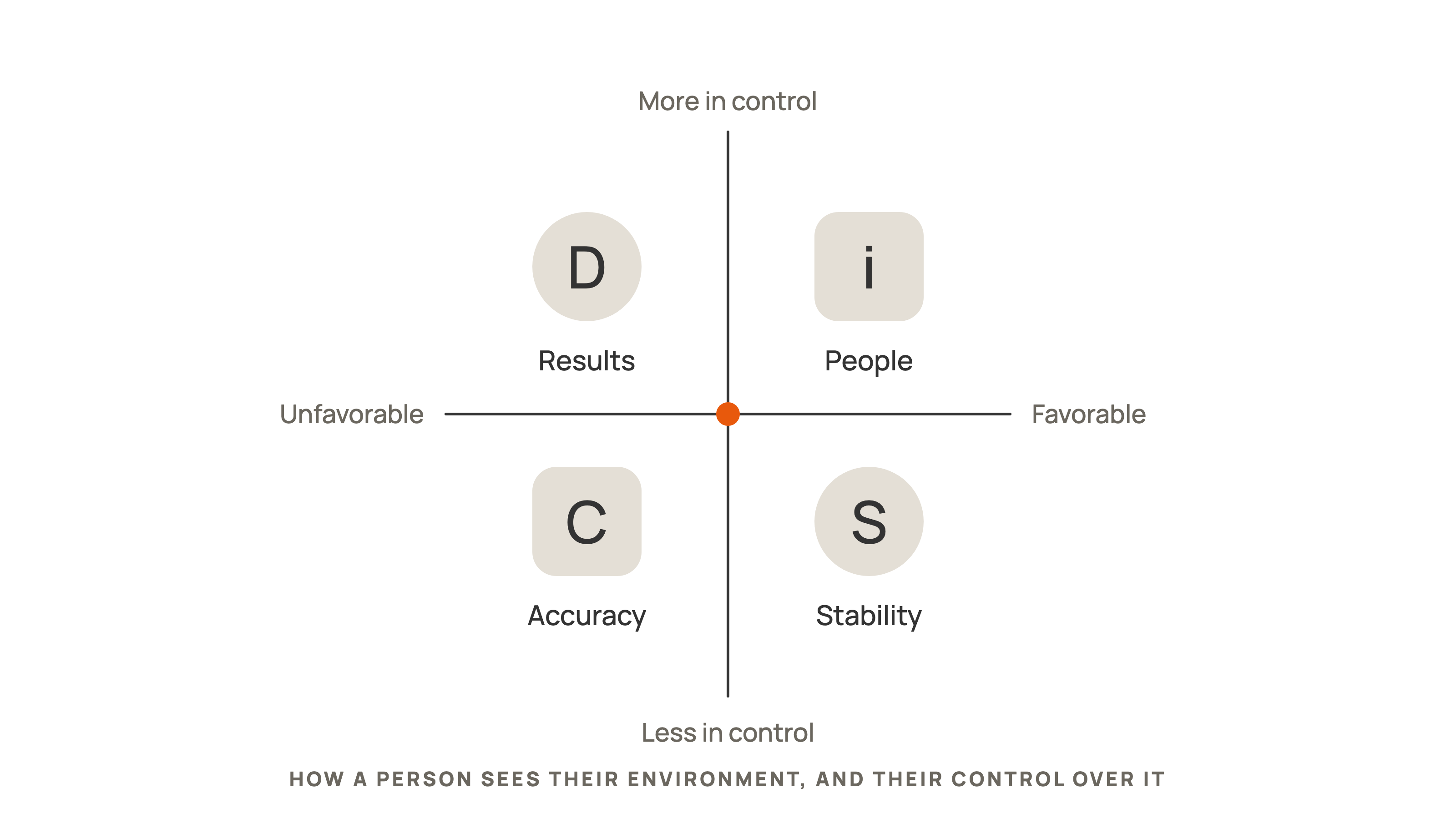
The DISC model began with psychologist William Moulton Marston, who described four patterns of emotional behavior in his 1928 book Emotions of Normal People. He built them on two questions. Does a person see their environment as favorable or unfavorable? And do they see themselves as more or less in control of it?
Marston never built an assessment. Industrial psychologist Walter V. Clarke later turned the theory into a questionnaire, and several publishers have developed their own versions since. Marston's original labels were Dominance, Inducement, Submission, and Compliance. Today most versions use Dominance, Influence, Steadiness, and Conscientiousness.
Marston is better known for two other things: an early blood pressure test for detecting deception, and the comic book character Wonder Woman. Behavior clearly interested him from more than one angle.
The four DISC styles
Each style describes a set of priorities, not a level of ability. Most people are a blend, with one or two styles showing up most often.
| Style | Focuses on | At their best | Under pressure | How to work with them |
|---|---|---|---|---|
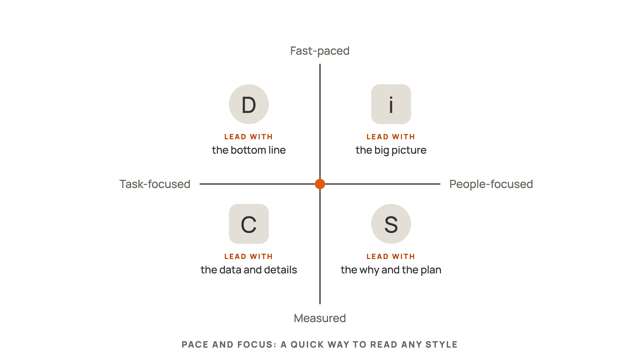
| D Dominance | Results, speed, control | Decisive and direct. Takes on hard problems. | Can turn blunt, impatient, or overriding. | Lead with the bottom line. Be brief. Offer options. |
| i Influence | People, energy, possibility | Persuasive and optimistic. Builds momentum. | Can overpromise, skip details, or avoid conflict. | Make room to talk it through. Confirm details in writing. |
| S Steadiness | Stability, support, collaboration | Patient, loyal, and reliable under load. | Can resist change or go quiet when they disagree. | Explain the why and the timeline. Ask them directly. |
| C Conscientiousness | Accuracy, quality, logic | Rigorous. Sees what others miss. | Can over-analyze, get critical, or stall a decision. | Bring the data. Define the standard. Give time to think. |
A high-S leader can be decisive. A high-D leader can be patient. It just costs them more energy, and knowing where your energy goes is useful information for you and for the people who work with you.
DISC vs. Myers-Briggs and other assessments
DISC describes how a person tends to behave and communicate in a given setting. Myers-Briggs, or MBTI, describes how a person prefers to take in information and make decisions, and sorts people into 16 types. DISC is usually easier to apply inside a team, because its four styles map directly onto what people can see in meetings, feedback, and decisions.
| DISC | Myers-Briggs (MBTI) | Big Five | |
|---|---|---|---|
| What it describes | Observable behavior and communication | Cognitive preferences | Broad personality traits |
| Structure | 4 styles, usually blended | 16 types | 5 trait scores on a spectrum |
| Best used for | Team communication, conflict, feedback | Personal reflection | Research and trait measurement |
| Easy to use in a live meeting | Yes | Harder with 16 types | Harder with 5 continuous scores |
If you want the most scientifically established personality model, that is the Big Five, which dominates academic research. DISC's research base is thinner, and publishers vary in how rigorously they validate their versions. That is exactly why I use DISC as a working language for a team and never as a verdict on who someone is.
What DISC is good for
DISC earns its place when it changes how people work together on an ordinary day.
- Giving a team neutral, shared language for friction, so "you're difficult" becomes "we're both under pressure and our styles are colliding"
- Preparing for a hard conversation with someone whose style is unlike yours
- Designing meetings so the quieter styles contribute before the fastest voices settle the question
- Helping a new leader understand a team they inherited
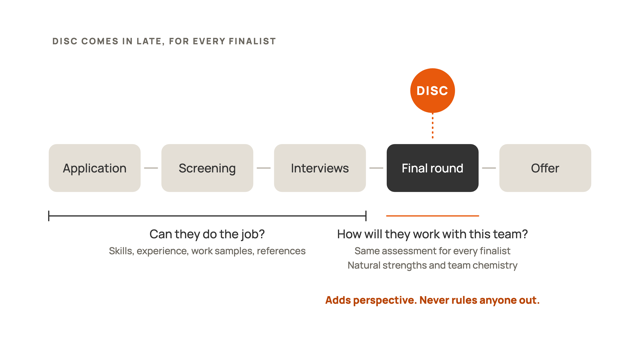
- Adding perspective in the final rounds of hiring, where it can show a candidate's natural strengths and how they might add to the chemistry of the team, without ever being used to rule someone out
What a DISC coaching engagement looks like
A DISC engagement follows a sequence, and the order matters.
- Individual assessments. Each person completes an online DISC assessment, which usually takes about 15 to 20 minutes.
- One-on-one debriefs. A coach walks each person through their profile and separates what rings true from what doesn't. The profile is a starting point for that conversation.
- The team map. The team sees its style mix together: where it's strong, where it's lopsided, and which voices tend to get lost.
- Applying it to real work. The coaching moves into actual meetings, decisions, and conflicts. This is where most of the value lives.
- Making it stick. Light follow-up keeps the shared language alive after the workshop energy fades.
Step four is where most DISC programs fall short. A workshop can produce a great afternoon and a stack of profiles nobody opens again. The goal is to change how next Tuesday's meeting runs.
I hold an ICA-accredited DISC Coaching Certification in executive coaching and team leadership, and DISC is one of the tools Meaning + Method uses with leaders and teams. It is where the conversation starts. It is never where it ends.
Frequently asked questions
What does DISC stand for?
DISC stands for Dominance, Influence, Steadiness, and Conscientiousness, the four behavioral styles in the model. Marston's original 1928 terms were Dominance, Inducement, Submission, and Compliance. Modern assessments updated the language, but the underlying idea is the same.
How long does a DISC assessment take?
Most DISC assessments take about 15 to 20 minutes to complete online. The assessment is the quick part. The value comes from the debrief and from applying the results to how a team actually communicates and decides.
Is DISC scientifically valid?
DISC is widely used in workplaces, but its research base is thinner than that of the Big Five, the model most academic researchers use. Quality also varies by publisher. Treat DISC as a practical framework for communication, teamwork, and understanding natural strengths, not as a clinical diagnosis or a pass or fail test.
Can your DISC style change?
Core tendencies tend to be fairly stable, but behavior adapts to role, context, and stress. Many people see their profile shift somewhat after a major role change, or find that they show up differently at work than at home. That flexibility is the point of coaching.
Is DISC useful for a small team?
Yes. A team of five can see its whole style mix in a single conversation, which often makes small teams the fastest to benefit. The smaller the team, the more each person's style shapes how every decision gets made.
Sources
- Marston, W. M. (1928). Emotions of Normal People. London: Kegan Paul, Trench, Trubner and Co.
- "DISC assessment." Overview of the model's history and development, including Walter V. Clarke's assessment work. Wikipedia