How to Use DISC in Hiring Without Screening Anyone Out
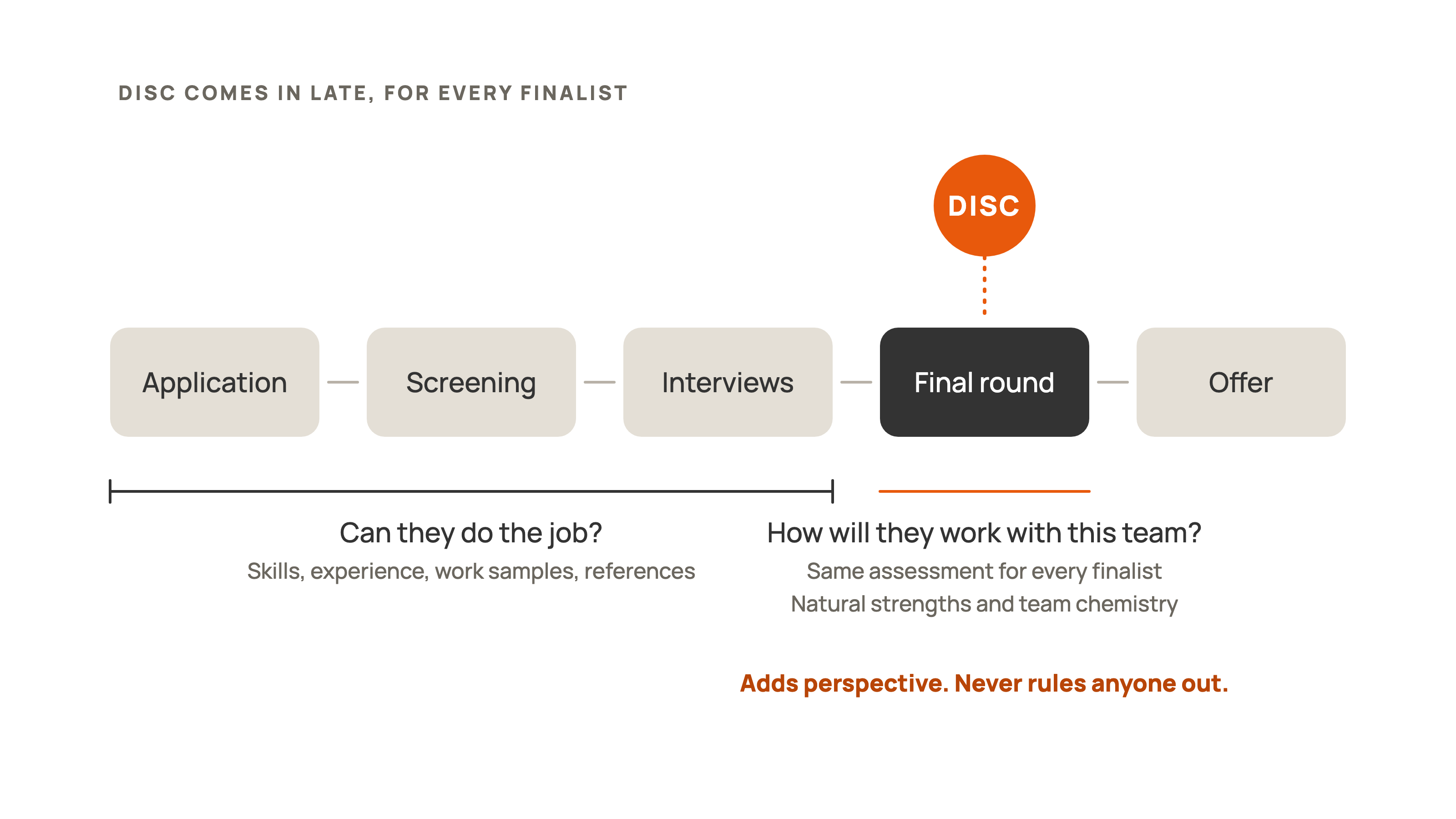
The short answerDISC is useful in hiring when it comes in late and adds perspective instead of making the decision. Give every finalist the same assessment in the last round, talk through the results with each one, and use what you learn about their natural strengths and how they might add to the team's chemistry. Never use it to rule someone out.
That last part is where most companies go wrong. They either avoid DISC in hiring entirely, or they use it as a filter early in the process and screen people out by style. Both waste what DISC is good at. Used well, it gives you a clearer picture of the person you're about to add to a team, at the moment you most need one.
Why DISC belongs late in the process, not early
Early hiring stages answer one question: can this person do the job? Experience, skills, work samples, and references answer that. DISC doesn't, because it describes how someone tends to work, not whether they can do the work.
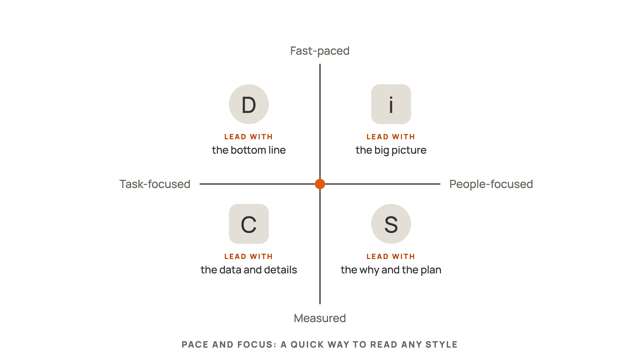
By the final round, the question changes. You're usually choosing between capable people, and the difference that matters is how each one will work with the team you already have. That's exactly what DISC is built to describe: pace, priorities, communication preferences, and how someone behaves under pressure.
So the timing isn't a technicality. It puts DISC in front of the question it's actually suited to answer.
Five steps to use DISC well in hiring
These steps work in order, because each one sets up the next.
1. Describe the role's working demands first
Before anyone takes an assessment, write down how the role actually works day to day. Does it need fast decisions or careful analysis? Constant collaboration or long stretches of independent focus? Lots of persuasion, or steady follow-through? Doing this first keeps you from reverse-engineering the job to fit a candidate you already like.
2. Map the team the person is joining
Look at the style mix of the team they'll work with most. A team heavy in one style often has a predictable gap. A group of fast, decisive leaders may be short on someone who slows down to check the details. A warm, steady team may need someone willing to push for a decision. Knowing the gap tells you what a new person could add.
3. Give every finalist the same assessment
Consistency matters for fairness and for good judgment. Use the same DISC assessment, at the same stage, for every finalist for the role. Never assess only the candidates you have doubts about.
4. Talk through the results with each candidate
A DISC profile is the start of a conversation. Walk each finalist through their results and ask what rings true and what doesn't. How someone talks about their own tendencies, especially the less flattering ones, often tells you more than the profile does.
5. Weigh it alongside everything else
DISC adds context to interviews, references, and work samples. It should never outweigh them. The question to ask is how a person's natural strengths fit what the role and the team need, not whether their profile matches an ideal.
Questions to ask in a DISC debrief
These open up a real conversation about how a candidate works:
- Which part of this profile sounds most like you at work?
- Which part doesn't sound like you at all?
- What kind of work gives you energy, and what drains you?
- How do you tend to act when a deadline is slipping?
- What do you need from a manager to do your best work?
- When you've worked with someone very different from you, what helped?
Team chemistry is about complement, not copies
The most common mistake with DISC in hiring is cloning. Leaders often warm to candidates whose style matches their own, because those conversations feel easy. A team built that way gets very good at one thing and blind to the rest.
Chemistry on a strong team usually comes from complement. The decisive leader benefits from someone who asks the careful question. The detail-focused team benefits from someone who builds energy and momentum. DISC helps you see those combinations deliberately instead of by accident.
What to avoid
- Using DISC as a cutoff. It describes style, so there is no passing score.
- Hunting for an "ideal profile." Strong performers come in every style.
- Assessing some candidates and not others. That's unfair, and it gives you uneven information.
- Letting the profile replace the interview. A report can't tell you how someone thinks through a real problem.
- Skipping the debrief. Results without conversation invite misreading.
A note on fairness and the law
In the United States, the EEOC's guidance on employment tests says selection tools can't be used to discriminate, and that a neutral-looking test can create liability if it disproportionately excludes people in a protected group without being job-related. It also recommends that employers make sure their tests are properly validated for the purposes they're used for, and keep them current as jobs change.
Using DISC late, consistently, and never as a screen is the most careful way to put it to work. Talk with your HR team or employment counsel about how assessments fit your own hiring process.
How Meaning + Method uses DISC
Our founder, Jason Neman, holds an ICA-accredited DISC Coaching Certification in executive coaching and team leadership. We use DISC with leadership teams to understand how they work together, and in late-round hiring to see where a candidate's natural strengths lie and how they might add to the team. It adds perspective. It never decides. For the basics of the model, start with What Is DISC Coaching?.
Frequently asked questions
Can you use DISC in hiring?
Yes, when it's used for perspective rather than as a filter. The strongest approach is to give every finalist the same DISC assessment in the last round, discuss the results with each one, and use what you learn about their natural strengths and team fit alongside interviews and references. It should never be the reason a candidate is excluded.
Is it legal to use personality assessments in hiring?
In the United States, employers can use assessments, but federal guidance says they can't be used to discriminate and shouldn't disproportionately exclude protected groups unless they're job-related. Apply any assessment consistently to every finalist, never use it as a sole screen, and check your approach with HR or employment counsel.
When should DISC come into the hiring process?
In the final round, once you've confirmed candidates can do the job. Earlier stages should focus on skills, experience, and work samples. DISC is most useful when you're choosing between capable people and want to understand how each would work with your team.
Should candidates see their DISC results?
Yes. Walking a candidate through their own profile turns the assessment into a conversation, shows respect, and gives you a much better read on how they see themselves. Many candidates find the debrief valuable whether or not they get the job.
Does DISC tell you how well someone will perform?
DISC shows how a person tends to work and communicate, which helps you picture them on your team. Judge capability through experience, work samples, and references, and use DISC to add context about how that capability will show up day to day.
Sources
- U.S. Equal Employment Opportunity Commission. (2007, December 1). Employment Tests and Selection Procedures. eeoc.gov
- Marston, W. M. (1928). Emotions of Normal People. London: Kegan Paul, Trench, Trubner and Co.