How to Communicate With Each DISC Style
The short answerTo communicate well with each DISC style, match the other person's pace and priorities. With a D, lead with the bottom line. With an i, make it personal and leave room to talk. With an S, explain the why and give them time. With a C, bring the data and the details, and expect good questions.
Most miscommunication at work isn't about what was said. It's about how it landed. The same message can feel efficient to one person and abrupt to another, thorough to one and exhausting to the next. DISC gives you a simple way to adjust before the message goes out.
Two questions to read anyone's style
You don't need an assessment to make a good first guess. Watch for two things.
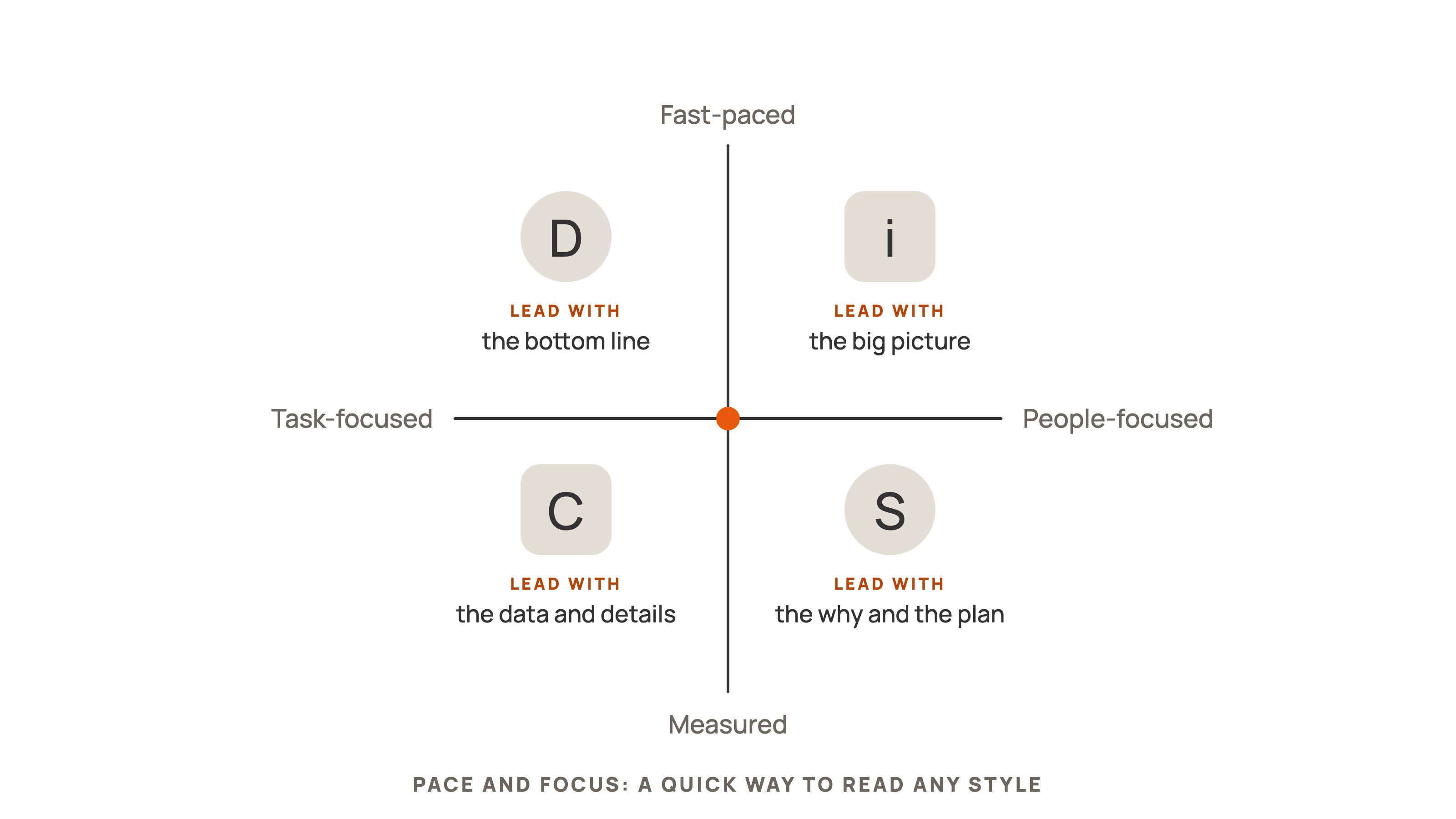
Pace. Does this person move fast, decide quickly, and speak up early? Or do they take their time, think before speaking, and prefer to weigh things first?
Focus. Do they lead with tasks, results, and facts? Or with people, relationships, and how everyone feels about it?
Put the two together and you have the four styles. Fast and task-focused is usually D. Fast and people-focused is usually i. Measured and people-focused is usually S. Measured and task-focused is usually C. This is a practical reading of the same two dimensions behind the model, which What Is DISC Coaching? covers in more depth.
Treat your read as a hypothesis. Most people are a blend, and everyone flexes depending on the situation.
How to communicate with each style
| D Dominance | i Influence | S Steadiness | C Conscientiousness | |
|---|---|---|---|---|
| Lead with | The bottom line | The big picture and the people | The why and the plan | The data and the details |
| In email | Short. Decision or ask in the first line. | Warm and conversational. A quick call may beat a long email. | Clear steps, timeline, and who's affected. | Complete and organized. Attach the supporting detail. |
| In meetings | Get to the point. Offer options, not essays. | Leave time to talk ideas through. Capture details after. | Give the agenda ahead. Invite their view directly. | Send material in advance. Expect and welcome questions. |
| Giving feedback | Direct and specific. Tie it to results. | Private, positive framing first, then specifics. | Gentle, private, and reassuring about the relationship. | Factual, with examples and a clear standard. |
| Avoid | Rambling, over-explaining, hedging | Cold, rushed, or all business | Surprises and sudden change | Vague claims, sloppiness, pressure to decide now |
Style by style
Communicating with a D
D styles value results, speed, and control. They respect directness and lose patience with long build-ups. Start with the conclusion or the decision you need, then offer supporting detail if they ask. When you disagree, say so plainly. A D generally respects someone who pushes back with a clear point more than someone who agrees to avoid friction.
Communicating with an i
i styles value people, energy, and possibility. They think out loud and build ideas in conversation. Give them room to talk, connect your idea to the people it affects, and show enthusiasm where you genuinely feel it. Because big-picture thinkers can skip details, follow up in writing with who is doing what by when.
Communicating with an S
S styles value stability, support, and collaboration. They want to understand why something is changing and how it affects the people involved. Explain the reasoning, lay out a clear plan, and give them time to process before you need an answer. Ask for their view directly, because an S may not volunteer disagreement in a group.
Communicating with a C
C styles value accuracy, quality, and logic. They want to get it right more than get it done fast. Bring evidence, be precise, and expect thorough questions, which are a sign of engagement, not resistance. Give them time with the material before a decision, and don't mistake careful analysis for stalling.
When styles collide
Some pairings create predictable friction. Knowing the pattern takes the sting out of it.
- D and S. The D wants to move now. The S wants to understand the impact first. The D can slow down enough to explain the why, and the S can say plainly what they need to commit.
- i and C. The i is excited about the idea. The C is checking whether it holds up. The i can bring a few concrete details, and the C can name what they like before listing concerns.
- D and C. Both are task-focused, but the D decides fast and the C decides carefully. Agree up front on what "enough information" means for this decision.
- i and S. Both are people-focused, but the i moves fast and the S prefers stability. The i can slow the pace of change, and the S can share their reservations early.
Flexing isn't faking
Adapting how you communicate isn't manipulation, and it isn't pretending to be someone you're not. You keep the same message and the same honesty. You change the delivery so the other person can actually take it in. It is a form of respect, and over time it makes teams faster, because less gets lost in translation.
Frequently asked questions
How can I tell someone's DISC style without an assessment?
Watch two things: pace and focus. Fast-paced, task-focused people often lean D. Fast-paced, people-focused people often lean i. Measured, people-focused people often lean S. Measured, task-focused people often lean C. Treat it as a starting guess, since most people are a blend.
What is the hardest DISC style pairing?
Pairings that differ on both pace and focus tend to create the most friction, such as D with S, or i with C. The difference isn't a problem in itself. It becomes one when nobody names it. Once a team can talk about style openly, those pairings often become their strongest partnerships.
How do you give feedback to a high D?
Be direct, specific, and brief. Lead with the issue and the result it affects, skip the long lead-in, and suggest a clear next step. A high D usually respects candor and will often prefer blunt feedback to softened feedback they have to decode.
How do you give feedback to a high S?
Choose a private setting, start by affirming the relationship, and be specific about the change you want. Give them time to respond rather than expecting an instant answer, and follow up to show the conversation didn't change how you see them.
Is adapting to someone's DISC style manipulative?
No. Manipulation changes the message to get something you're not entitled to. Adapting keeps the message honest and changes the delivery so it can be heard. It's the same thing good leaders already do instinctively, made deliberate.
Sources
- Marston, W. M. (1928). Emotions of Normal People. London: Kegan Paul, Trench, Trubner and Co.
- "DISC assessment." Overview of the model's development and the four styles. Wikipedia